
SCOBY-Based Biomaterials for Sustainable Generative Design and Architecture
Introduction
Home brewers are familiar with the need to dispose of excess SCOBYs they peel off from multiple ferments. Some embrace Hannah Crum’s recipe for SCOBY Fruit Leather. Others feed the pellicles to their pets. Commercial brewers face this challenge on a far larger scale. Recycling the material for composting or natural gas production are the more environmentally friendly options.
But what about the potential for SCOBY pellicles to go beyond fruit, Fido, or fertilizer?
From pictures of Sacha Laurin’s award-winning SCOBY fabric designs featured in the Fall 2021 edition of SYMBIOSIS Magazine, to the Imperial College, London research on vegan leather production, and Shajia Meraj’s art inquiring into grief, memory, and circularity, people are experimenting with creative uses for the pellicle.
A new research paper, From Kombucha to Architecture: Transforming SCOBY into a Sustainable Biomaterial for Generative Design Solutions, by Curro Polo and José Antonio Carrillo Andrada, was published July 2, 2026, by Springer following the SCIN 2025 conference (Sustainable Creative Art: Inspiration from Nature). These scientists, associated with the American University in Dubai and Harvard University, set out to explore the question: can bacterial cellulose grown from kombucha SCOBY meet the mechanical and environmental demands of design applications, from small culinary objects to furniture and architectural skins? The result is a bridge: from materials grown through the living process of fermentation, into a computational design environment, and from there toward architecture.
From kombucha to architecture
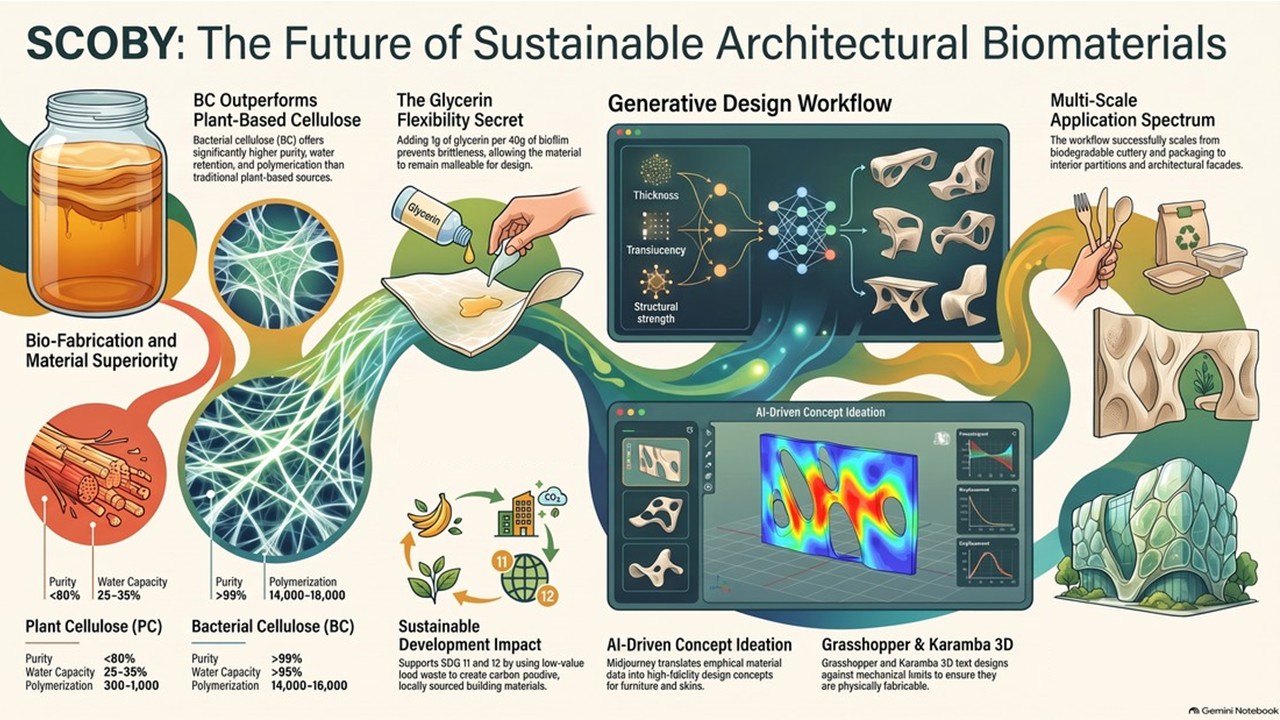
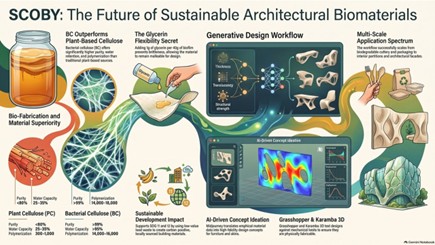
Their research outlines a pioneering interdisciplinary framework that bridges food science, architecture, and computational design to transform bacterial cellulose (BC) harvested from kombucha SCOBY into a high-performance, sustainable biomaterial. They describe in detail the production methods employed, including creative ways to improve malleability, share creative AI-generated images, and employ tools to productize these. The study demonstrates that BC can meet mechanical and environmental requirements for applications ranging from biodegradable culinary artifacts to architectural skins.
Key findings indicate that BC possesses superior industrial properties compared to plant-based cellulose (PC), including higher purity and water retention. Mechanical testing reveals that the material is highly sensitive to humidity, a characteristic that allows it to function as a “responsive agent” in design.
The research establishes a reproducible “software–wetware–hardware” pipeline that aligns with the United Nations Sustainable Development Goals (SDGs) 11 and 12 by promoting closed-loop production, waste reduction, and the use of locally sourced, compostable building materials that help “make cities and human settlements inclusive, safe, resilient and sustainable.”
The SCOBY in a post-anthropocentric world
Just as Pakistani student Meraj celebrated the SCOBY as a time-based medium that responds to its environment and the care it receives, so Carrillo and Pollo adopted a post-anthropocentric paradigm, viewing SCOBY-BC as a “co-designer” rather than a passive resource. The material’s natural behaviors—such as shrinking, thickening, and patinating over time—are embraced as design drivers. This shift from permanence to ephemerality enables “soil-positive disposal,” in which architectural and culinary artifacts reintegrate into ecosystems at the end of their lifecycles.
They blend scientific rigor with an artistic approach that “thrives on intuition, distorting reality to enhance the human experience.” In a passage worth quoting at length from Section 5, “SCOBY in the Post-anthropocentric World,” they state:
The post-anthropocentric paradigm challenges the dominant notion of human supremacy over nature, advocating instead for a model of co-design and interdependence with nonhuman agents. This framework values all forms of life and their interconnected systems, situating environmental and nonhuman well-being as integral to design ethics and sustainability.
Within this context, SCOBY’s derived cellulose emerges not simply as a material but as a responsive and evolving agent. Its self-assembling behavior, sensitivity to humidity and growth-dependent mechanical properties … suggest a material that behaves dynamically rather than passively. These characteristics align with Scarpitti and Valsecchi’s (2023) notion of biomaterials possessing intrinsic value beyond utility, forming part of a living, co-creative design system.
The boundary-crossing nature of SCOBY, between the living and non-living, is evident in both its biological variability and design responsiveness. In our study, changes in environmental conditions directly altered SCOBY’s BC tensile performance and biodegradability. This supports a design approach where material behavior itself becomes a driver, not just a constraint. These observations resonate with bio-art principles (Carrillo Andrada et al., 2024), where living materials are not controlled but engaged as collaborators in both aesthetic and scientific exploration.
The paper explores the artistic possibilities of the SCOBY by presenting a number of Midjourney images.
Picture this
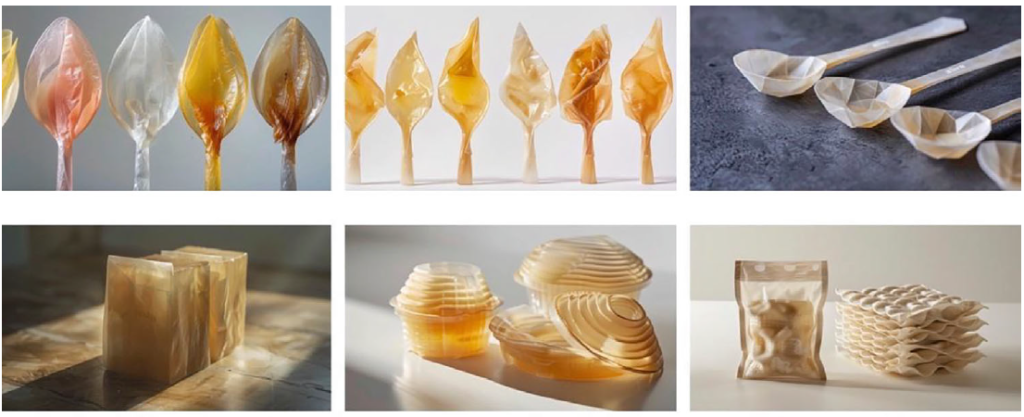
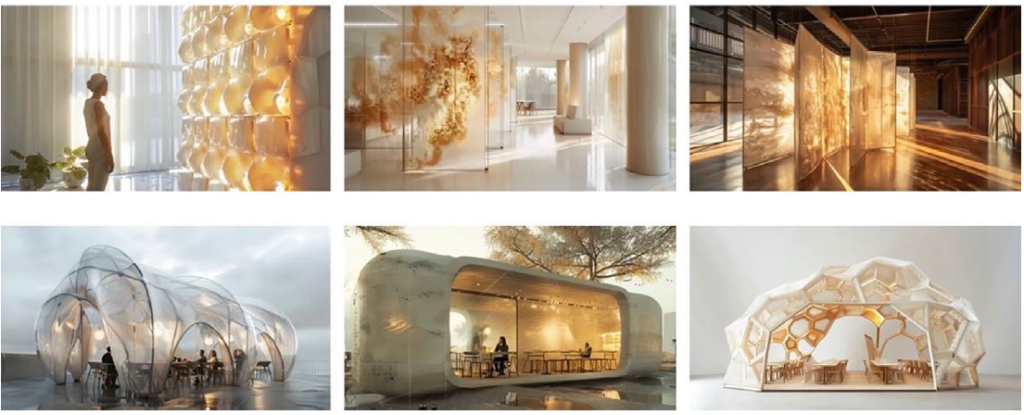
Images were generated with Midjourney prompts to enable “conceptual ideation to functional prototypes that range from cutlery and packaging to building facades, pop-up restaurants and interior partitions.” These range from ‘low-value food-grade by-products’ (UN SDG 12)
to the architectural design of buildings with ‘compostable skins that reduce the environmental impact of cities’ (UN SDG 11)
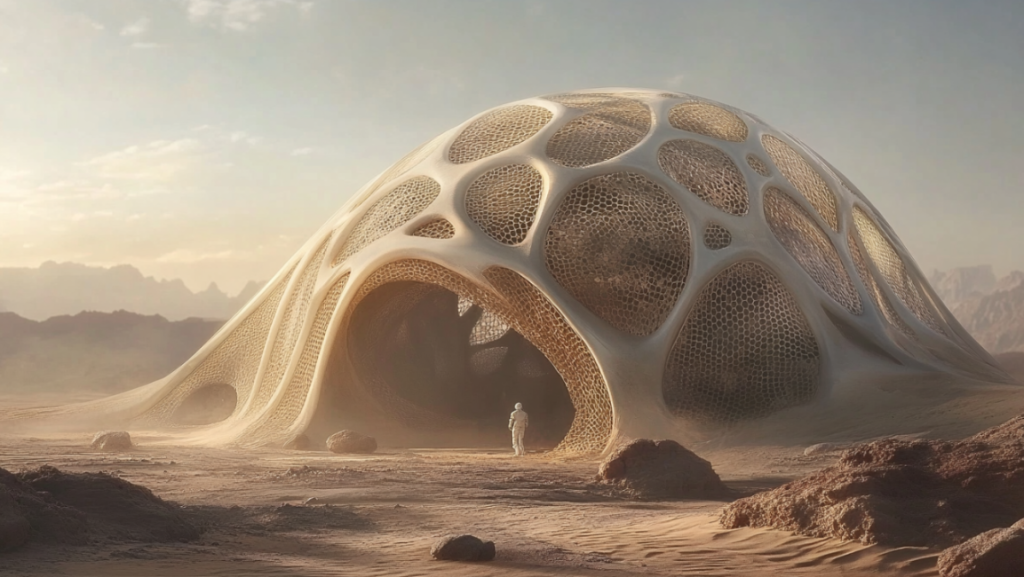
These images inspired me to imagine the fermented dome of a future Martian colony, and to speculate about extraterrestrial fermentation that I introduced in Episode 12 of ‘Our Fermented Future‘, anticipating a time when “In the silent vacuum of the cosmos, the gentle bubbling of fermentation tanks became the heartbeat of life.”
The field of dreams: From design to prototypes
The paper suggests that these images can be fabricated with the help visual scripting tools such as Grasshopper 3D:
Each selected Midjourney frame is rebuilt in a single Grasshopper script that automatically imposes mechanical limits such as sheet thickness, minimum bend radius and panel size. If any curve tightens beyond the experimentally verified radius, the model flags itself “not fabricable”; otherwise, it exports watertight geometry together with the original Midjourney seed and prompt ID. These data are later assessed in Karamba 3D, a parametric structural engineering plugin for Grasshopper that enables interactive analysis and optimization of load-bearing structures.
The result? “Once a design passes simulation, physical realization will follow.” Build it, and they will come, eh lads?
Disclaimer
This report was created with the help of Gemini Notebook and Midjourney. It is as accurate as possible. However, readers should refer to the source material for verification.




The Register reports that researchers from The Hong Kong University of Science and Technology and The Hong Kong Polytechnic University have published a paper describing how Mars astronauts could live in houses made of yeast and jello.