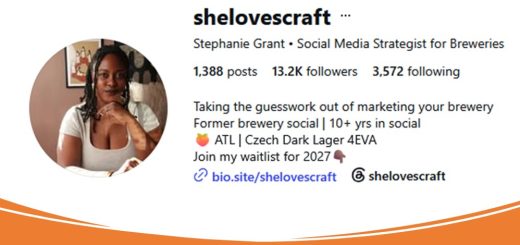
Profile: Stephanie Grant, Social Media Strategist

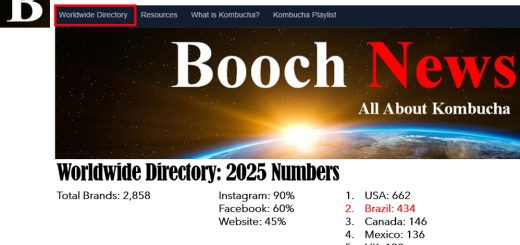
Stephanie Grant is an Atlanta, Georgia-based storytelling and social media strategy consultant for craft beer breweries. Her work caught my attention when I saw her October 2026 post on how to audit your Instagram account. One of the biggest issues she saw was that key facts were missing from the profile or bio. This resonated with me because I’ve spent the last eight years building the Booch News Worldwide Directory by researching kombucha brands online. Countless times, I’ve had to dig deep to find where a company was located before I could add them to the Directory. This is information that should be listed on the main page on Instagram. Stephanie’s recommendations apply as much to kombucha brands as to craft beer brewers.
I’ve spent a lot of time auditing brewery Instagram profiles this year. And even before it was officially my job, I was looking at brewery accounts constantly. I’d land on a profile and couldn’t figure out what made them different from the brewery down the street. Or where they were even located. Or why I should care enough to follow.
I recently wrote an article for the @brewersassoc about how to audit your Instagram account, and one of the biggest issues I kept seeing is that there are elements either missing from the profile entirely or the bio just doesn’t do enough to pull someone in and make them want to pay attention to what you’re doing.
So I put together this carousel to break down every element of your bio, what it needs to include, and how to set it up so that when someone lands on your profile for the first time, they know exactly who you are and why they should follow you.
An effective Instagram Bio
Stephanie’s recommendations for an effective Instagram Profile include:
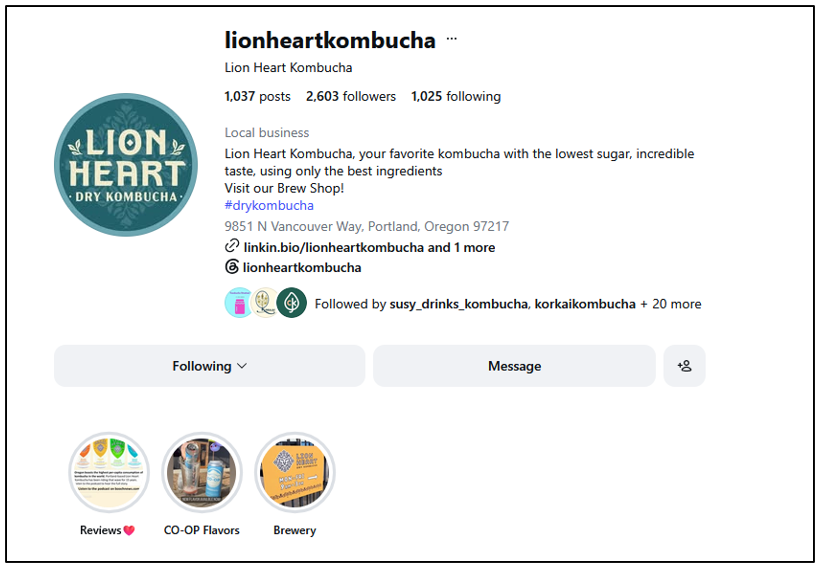
- Profile Photo: Use a logo that is clean and easy to read at a small size. If your logo has a lot of detail, use a simplified version.
- Name Field: The text at the top of the Profile is searchable. Including your location makes it easier for people to find you.
- Bio Line #1: The first line of your bio should tell someone who you are and what you are all about. It should say what makes you different. Think how you would would finish the sentence “We’re the kombucha that…”
- Bio Line #2: Great for talking about your credentials such as awards or recognition.
- Bio Line #3: Great for pointing people somewhere specific.
- Link in Bio: Instagram let’s you add five links. Put the most important or time-sensitive at the top.
- Highlights: A mini-introduction. Pick 3 to 6 intentional ones such as ‘About Us’ and ‘FAQ’. Keep names to 9 characters so they don’t get cut off. Check monthly so they don’t seem stale.
Here’s an example of a kombucha brand that meets many of these guidelines. I visited Portland’s Lion Heart Kombucha in July 2024.
Three pillars of social media
I recommend that people post three types of content.
You need to post content that tells people who you are. And that includes your values, your founding story, things about your team, those kinds of things, like who are you? Because people want to know who they’re buying from. And that’s gotten more important over time. Gen Z likes to put their money towards people who share similar values. I’d say the same about millennials.
You also want to post about what you offer. And I always say this goes beyond just the product that you have, but what also surrounds the product? And of course, for breweries, that is the hospitality and everything you experience in the physical space. But for a product that’s on the shelf, especially something like kombucha, you can talk about health benefits, such as how it is really good for your gut microbiome. Talk about the things that add value to the product. Talk about the ingredients that you use.
You can even talk about the type of person that you’ve created this for, because every kombucha is not made the same. And there’s going to be, I would imagine, people who see a particular kombucha on the shelf and think, I actually want my kombucha to be this way. So, talk about that.
And then we want to talk about why someone should buy your product. So, for taprooms, I typically say why someone should visit your space. But if you have your product on shelves, why should someone pick it up off the shelf? And what is that experience going to be like for them? What are the benefits? And there’s some overlap, I would say; there’s some overlap between what you offer and why someone should buy it, but they both are necessary.
And I think a lot of vendors just focus on “buy the product, buy the product,” and don’t let people know who they are or what makes the product special. That’s very important for buyers. These are the things they consider when deciding to purchase a product. This third tier, the why you should buy it, it is really a direct call to action. The other two pillars are more informational. People like to be told, “Buy this product,” or “Try this product out.” And I think having that direct call to action ensures that you are being very clear that you would really like them to try your product, fall in love with your product, and keep their fridge stocked with it.
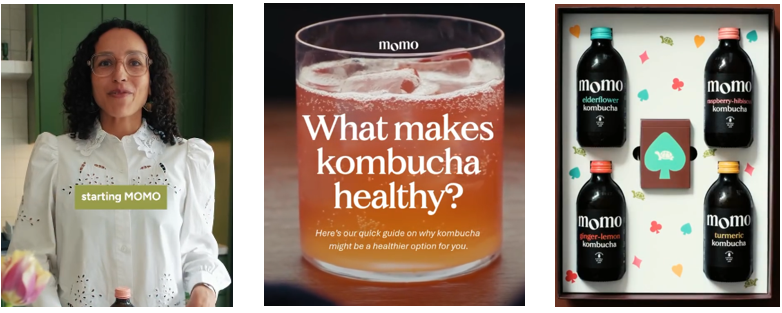
I’d suggest these Instagram posts from the UK’s Momo Kombucha are nice examples of the three content pillars:
- Who they are. “What started as a small kitchen setup in South East London has grown into a full scale brewery,”
- What they offer. “Why is kombucha considered a healthy choice?”
- Call to action. “Meet the MOMO Gift Set. Whether it’s a festive get-together or a quiet evening with good company, this is a gift made for sharing.”
Consulting Engagement
Stephanie offers a $1,950 90-day consulting engagement that includes “Everything you need to go from guessing to knowing“:
THE AUDIT We start by taking a deep look at where you are right now — your content, your presence, your process, and your goals. You’ll get an honest outside perspective on what’s working, what isn’t, and what’s missing. This is the foundation everything else gets built on.THE STRATEGY This is not a generic content strategy. It’s custom built specifically for your brewery—your goals, your audience, your story. You’ll leave with a monthly planning process, a storytelling framework, and a clear direction for every piece of content you create.
THE IMPLEMENTATION SUPPORT A strategy is only as good as what you do with it. Over the following two months, you’ll have ongoing support as you put it all into practice— async weekly check-ins, real feedback, and someone in your corner when you hit a roadblock. You won’t be figuring it out alone anymore.
The end result is to give you the skills to keep going long after the 90 days are done.
She recommends most brands focus on Instagram for the best ROI.
Stephanie can be reached at stephanie@shelovescraft.com.
Podcast
Listen to the podcast to hear Stephanie describe her consulting services.
Podcast: Play in new window | Download
Subscribe: Spotify | Pandora | iHeartRadio | TuneIn | RSS